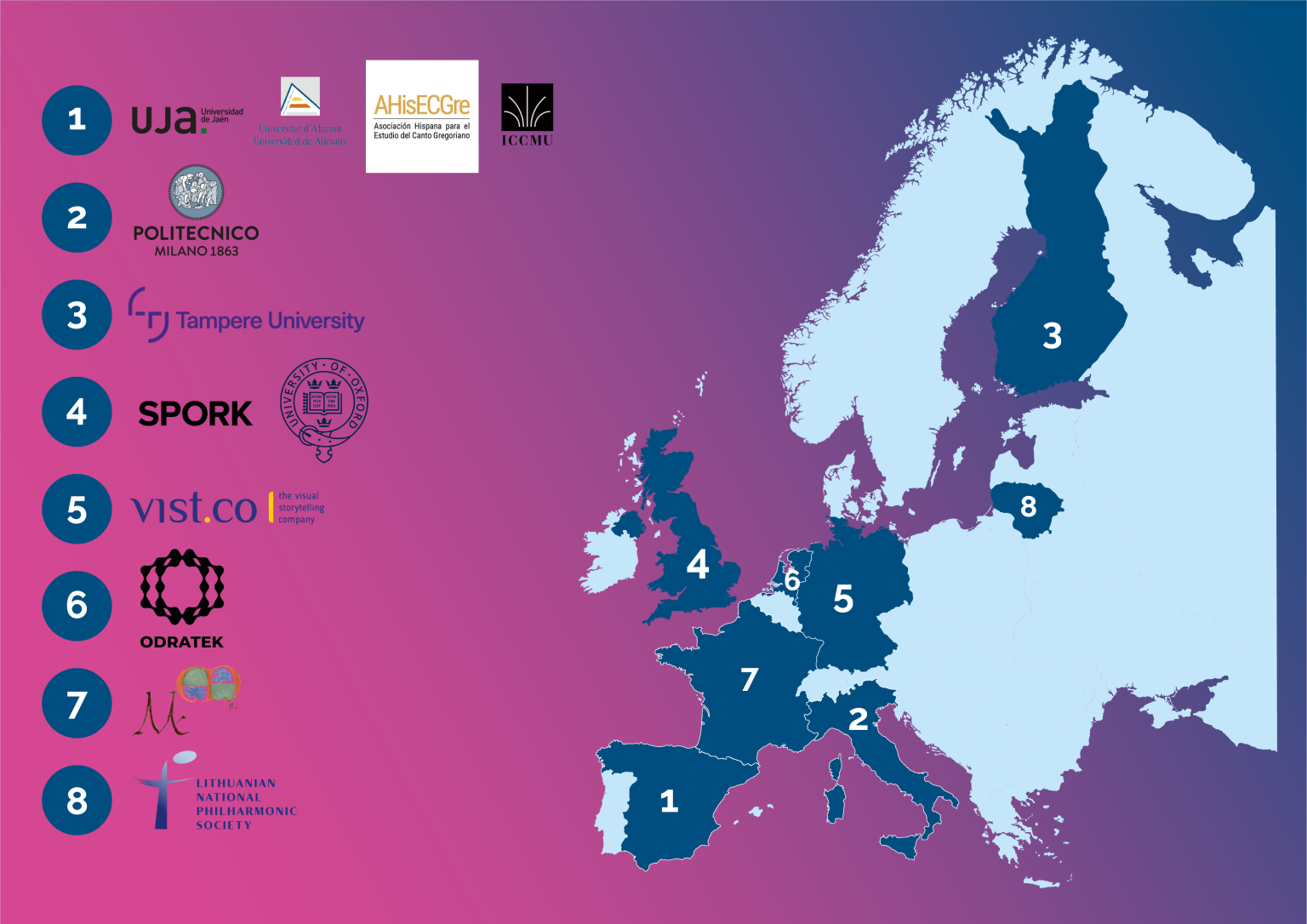
The Repertorium project brings together technological, musicological, and creative research to preserve and reinterpret Europe’s musical heritage through artificial intelligence. This section presents the main research results developed by the consortium partners all contributing to the creation of innovative tools for studying, performing, and experiencing classical music in new digital forms.
Optical Music Recognition
An Optical Music Recognition system that converts medieval and classical scores into structured digital formats.
University of Alicante
Sound Source Separation
A deep-learning system for isolating individual instruments from orchestral recordings.
Tampere University
University of Jaén
Spatial Audio and Immersive Streaming
A spatial-audio tool for reconstructing and streaming 3D concert-hall sound fields with six-degrees-of-freedom navigation.
Polytechnic University of Milan
Musicological Data Annotation and Indexing
A toolset for training Optical Music Recognition models, indexing rare manuscripts, and linking digitized chants to public music databases.
Instituto Complutense de Ciencias Musicales (ICCMU)
Universidad Complutense Madrid (UCM)
Medieval Music Manuscripts Online (MMMO)
A digital platform providing open access to the Solesmes Abbey manuscript archive, featuring 1,474 digitised reproductions and 155,000 indexed chants linked to the Cantus Index.
Open Source
Resulting optical music recognition tools for medieval and classical manuscripts, music information retrieval medieval cataloguing tools, and instrumental sound source separation and sound field reconstruction testing materials will be licenced under Creative Commons licences (Attribution, Non-Commercial, Share Alike, CC BY-NC-SA) and delivered to public repositories. All training data will be licenced as public domain and shared to allow for the reproducibility of the research. In those cases in which partners intend to seek patents for their machine learning algorithms, sufficient materials will be granted to ensure the reproducibility of scientific results while protecting the partner’s intellectual property.
Overall, REPERTORIUM will generally widen the accessibility, appeal, and knowledge of classical music heritage among the public and academics.
In addition, the project represents a significant step towards creating a general musical artificial intelligence with machine equivalents for eyes, ears, memory, intellect, and imagination. Doing so is an important contribution to exploring the AI-human values alignment problem by making European cultural heritage available to machine learning solutions. The project is an essential step towards the evolution of artificial intelligence that can authentically reflect human civilisation’s implicit values while achieving its programmers’ explicit objectives.
REPERTORIUM builds our future from our past by preparing the ground for an AI to understand and conform to human intentions, preferences, and goals as embodied in centuries of European civilisation’s traditions and artefacts. REPERTORIUM will serve as a model in shaping our new human-centred digital world.